DualSense Edge Review: Is It Worth $199?
What $199 buys over the $74 DualSense: swappable stick modules, back buttons, trigger stops, and a battery downgrade Sony hopes you will not notice.
The short answer: the Sony DualSense Edge ($199) is worth it for daily players, because its swappable stick modules turn a worn stick into a cheap swap, not a dead controller. For casual play the standard DualSense ($74) is plenty. The full comparison is below, based on manufacturer specifications and research.
GTA 6 lands on PS5 and Xbox on Thursday November 19, 2026, and whatever controller is in your hands at 00:01 will log more hours before March than most pads see in their whole lives. Sony's pitch for that job is the DualSense Edge: the standard pad's haptics and adaptive triggers, plus swappable stick modules, two back buttons, trigger stops, custom profiles, and a price of $199.
That is 2.7 times the $74 standard DualSense. The question is not whether the Edge is better. It is. The question is whether the extra $125 buys $125 of controller, because that same gap nearly covers a 2TB SSD from our PS5 storage rankings, and a full console only matters if you can store the game on it.
The short version: the Edge is the best first-party PS5 controller you can buy, the stick modules are the one feature that justifies the price, and the battery is a genuine downgrade Sony printed in small type. It is also not the most drift-proof controller at this money. Details below.
The field at a glance
Four controllers, one baseline, three ways to spend pro-pad money. All figures are manufacturer ratings.
| Model | sticks | triggers | back buttons | battery | Price | Link |
|---|---|---|---|---|---|---|
| Sony DualSense EdgeTHE PICK | Swappable modules, adjustable tension caps | 3-position stops | 2 (half-dome or lever) | 5-6h typical | $199 | Check |
| Sony DualSense (standard) | Fixed, standard tension | Adaptive, no stops | None | 8-10h typical | $74 | Check |
| Victrix Pro BFG | Swappable gates + modules | 5-position stops | 4 | 20h+ rated | $169 | Check |
| Razer Wolverine V2 Pro (PS5) | Hall-effect, drift-resistant | Mecha-tactile stops | 6 programmable | 10h+ rated | $150 | Check |
The verdict
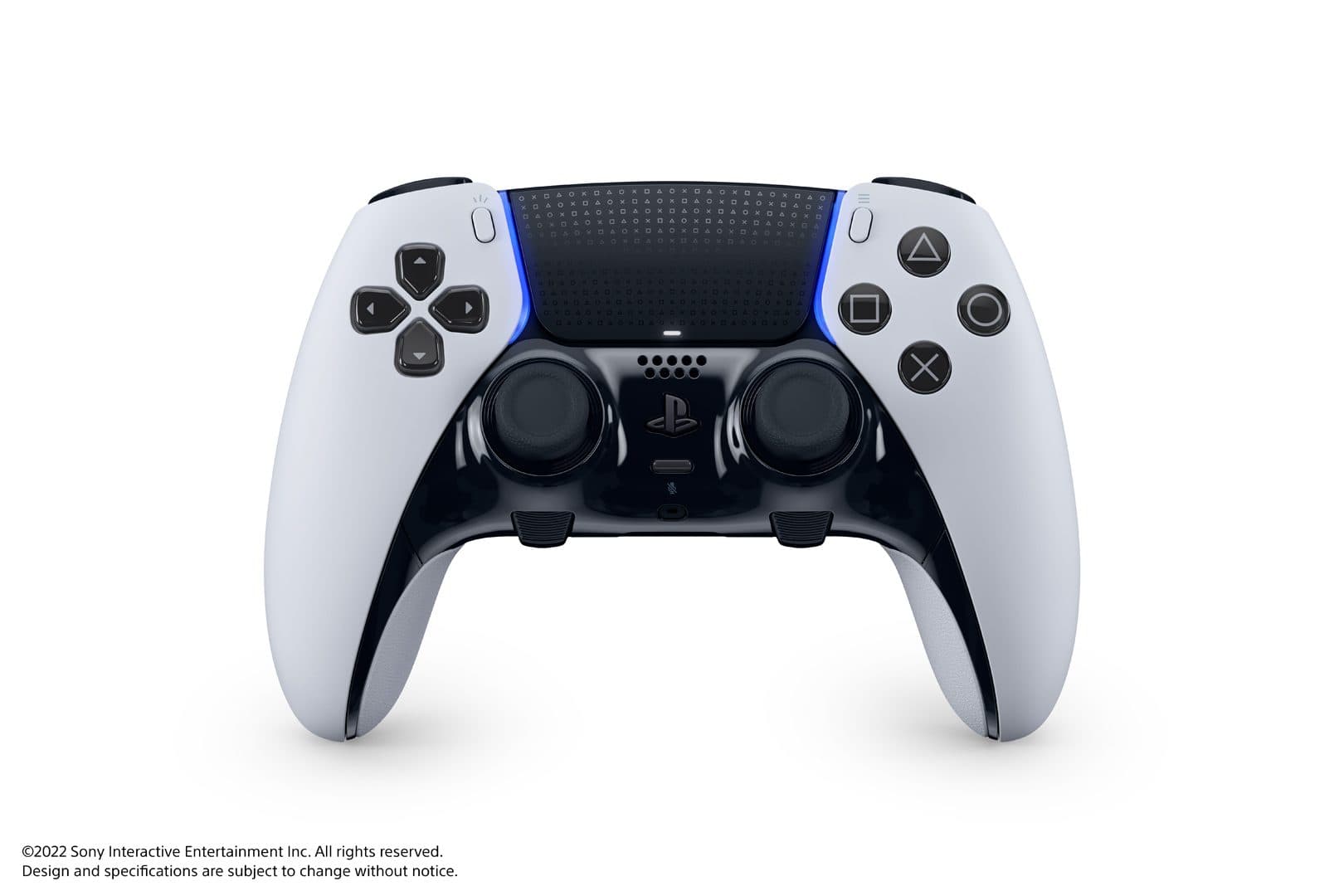
Sony
Sony DualSense Edge
- sticks
- Swappable modules, adjustable tension caps
- triggers
- 3-position stops
- back buttons
- 2 (half-dome or lever)
- battery
- 5-6h typical
- extras
- Carry case, braided cable lock
$199
Checked at publish
Affiliate link. We may earn a commission at no extra cost to you.
On paper, the Edge is the best first-party PS5 controller you can buy, and worth the $199 if you play daily. The case rests on one structural argument: it is the only controller here that keeps every PS5 platform feature, haptics, adaptive triggers, the lot, while making the most failure-prone part of any controller a user-replaceable component. It works against itself on a battery spec that goes backwards from the $74 pad it replaces, and on the fact that at this price tier, rivals have moved to stick sensors that resist drift instead of just making drift cheaper to fix. This verdict is built on manufacturer specifications and research, not our own long-term wear testing.
What $199 buys over the standard pad
Line by line, here is where the $125 premium goes.
The killer feature: swappable stick modules
Stick drift is the most common way a modern controller dies. On a standard DualSense, a drifting stick means a warranty claim if you are inside the window and a new $74 controller if you are not. There is no third option, because the sticks are soldered into the assembly.
The Edge makes the entire stick module a cartridge. Release the faceplate, pop the module, seat a new one, done. No soldering iron, no spudger, no watching a teardown video with your console in pieces. The module also carries adjustable tension caps, so you can run a taller dome on your aim stick and a shorter cap on movement, which is the kind of thing that sounds cosmetic until you change it back and notice.
This is the feature doing the heavy lifting in the price. Think of it as drift insurance: the premium is built into the purchase, and the payout is that a worn stick costs you a module instead of a controller. For a pad that is about to absorb a few hundred hours of one open world, insurance on the part most likely to fail is a rational spend.
Be clear about what it is not. The sensor inside the module is the same style as the standard pad's, so the Edge does not prevent drift, it prices it down. Rivals took the other road, and we cover that in the alternatives section.
Back buttons: two, your choice of shape
The Edge takes two rear inputs, and Sony ships both shapes in the case: half-dome buttons or longer levers, swap at will. Map them to anything. The standard use case writes itself: jump and reload on the paddles, thumbs never leave the sticks, and claw grip retires.
Two is the conservative number. The Victrix Pro BFG carries four and the Razer Wolverine V2 Pro carries six programmable rear inputs, so if your muscle memory wants a full extra hand of buttons, the Edge is the modest option in this field. For most players two is the right amount: it covers the two actions you actually need mid-aim without turning the back of the controller into a piano.
Trigger stops: three positions
A physical slider behind each trigger sets three travel positions, from full adaptive-trigger throw to a short competitive stop. Shooters get the short stop, racing and everything that uses Sony's adaptive resistance gets the full throw, and switching is a flick, not a menu. The Wolverine answers with mecha-tactile stops and the Victrix goes further with five positions, but three is enough granularity to cover the genres that care.
Profiles, the Fn buttons, and the case
The Edge stores custom profiles, remaps, stick sensitivity curves, dead zones, trigger ranges, and switches between them from Fn buttons on the controller itself, no trip to the console menu mid-match. Set a shooter profile with short stops and paddles, a driving profile with full trigger throw, and swap as the game changes. The hardware extras round it out: a hard carry case and a braided USB cable with a lock housing that keeps wired play wired when the cable gets stood on.
None of this is individually worth $125. Collectively it is the difference between a controller you configure once in a settings menu and one you adjust on the fly, which matters more in a 200-hour game than in a weekend rental.
The trap: the battery
Here is the line item Sony would rather you skim. The standard DualSense runs 8 to 10 hours typical. The Edge runs 5 to 6. The pro controller, at three times the price, holds two thirds the charge, because the extra hardware eats into the same body and the cell shrank to make room.
Manufacturer-rated and typical battery figures, the full field:
| Victrix Pro BFG | 20H+ |
|---|---|
| Wolverine V2 Pro | 10H+ |
| DualSense | 8-10H |
| DualSense Edge | 5-6H |
Read that chart again. The $199 first-party flagship is last, behind its own $74 sibling, at half the Wolverine's rating and barely a quarter of the Victrix's. A 5 to 6 hour cell means a long Saturday session ends on the cable. The lock housing on the braided cable is Sony quietly acknowledging how often you will be using it. If cordless endurance is your first requirement, the Edge is the wrong controller in this table, full stop.
The baseline: the standard DualSense at $74
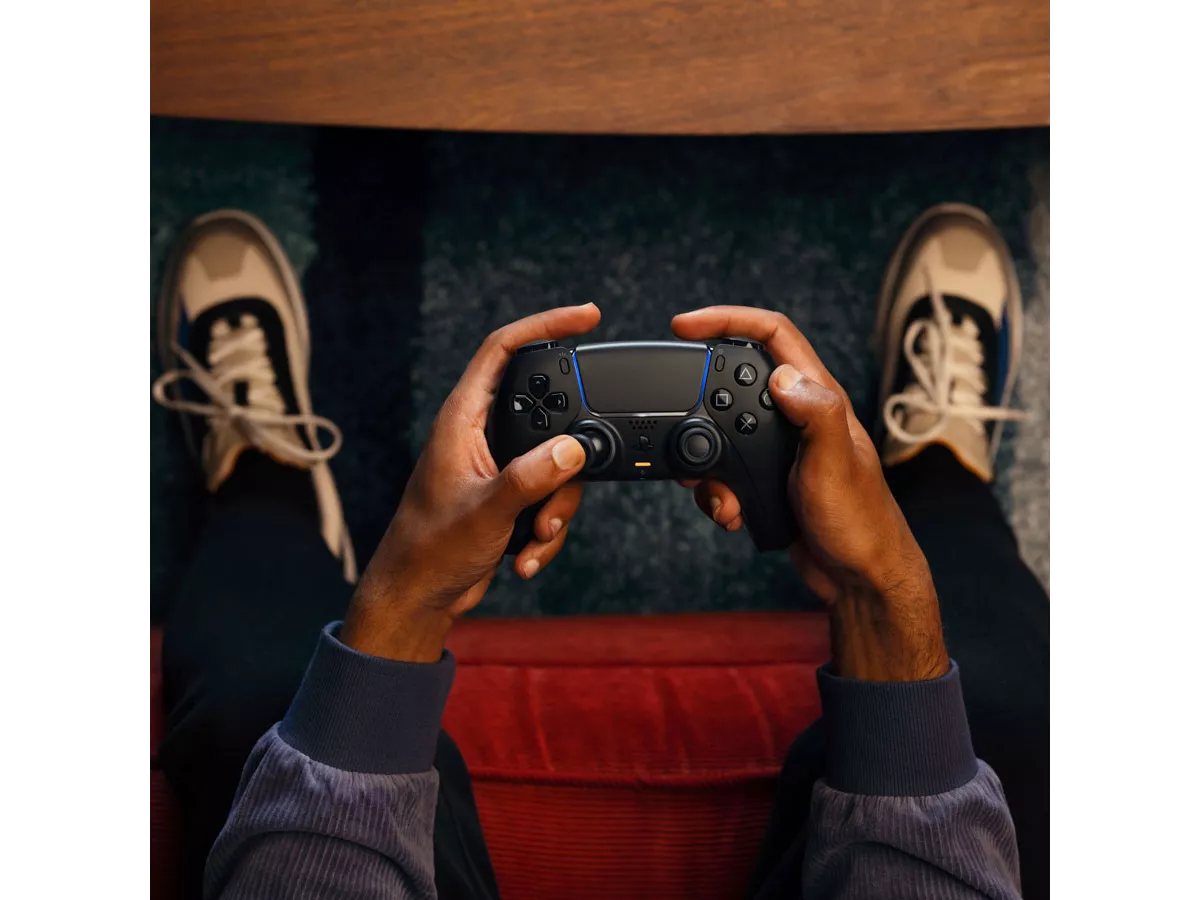
Sony
Sony DualSense (standard)
- sticks
- Fixed, standard tension
- triggers
- Adaptive, no stops
- back buttons
- None
- battery
- 8-10h typical
- extras
- Haptics + adaptive triggers
$74
Checked at publish
Affiliate link. We may earn a commission at no extra cost to you.
The control group, and a genuinely good controller. Haptics and adaptive triggers are the same experience as the Edge, the battery runs 8 to 10 hours typical, and it costs less than a third as much. What it lacks is everything structural: fixed sticks with no repair path short of replacement, no back buttons, no trigger stops, no stored profiles.
The honest framing: the standard DualSense is the right buy for anyone who plays casually, shares a console, or needs a second pad. The Edge case only opens when the hours pile up, because that is when sticks wear and that is when paddles and profiles pay rent. If you are reading a 2,000 word review of a controller, you are probably past that threshold, but buy the standard pad for player two either way.
The alternatives
Two third-party pads sit just below the Edge on price, one $30 under it, one $49 under.
The backup: Victrix Pro BFG
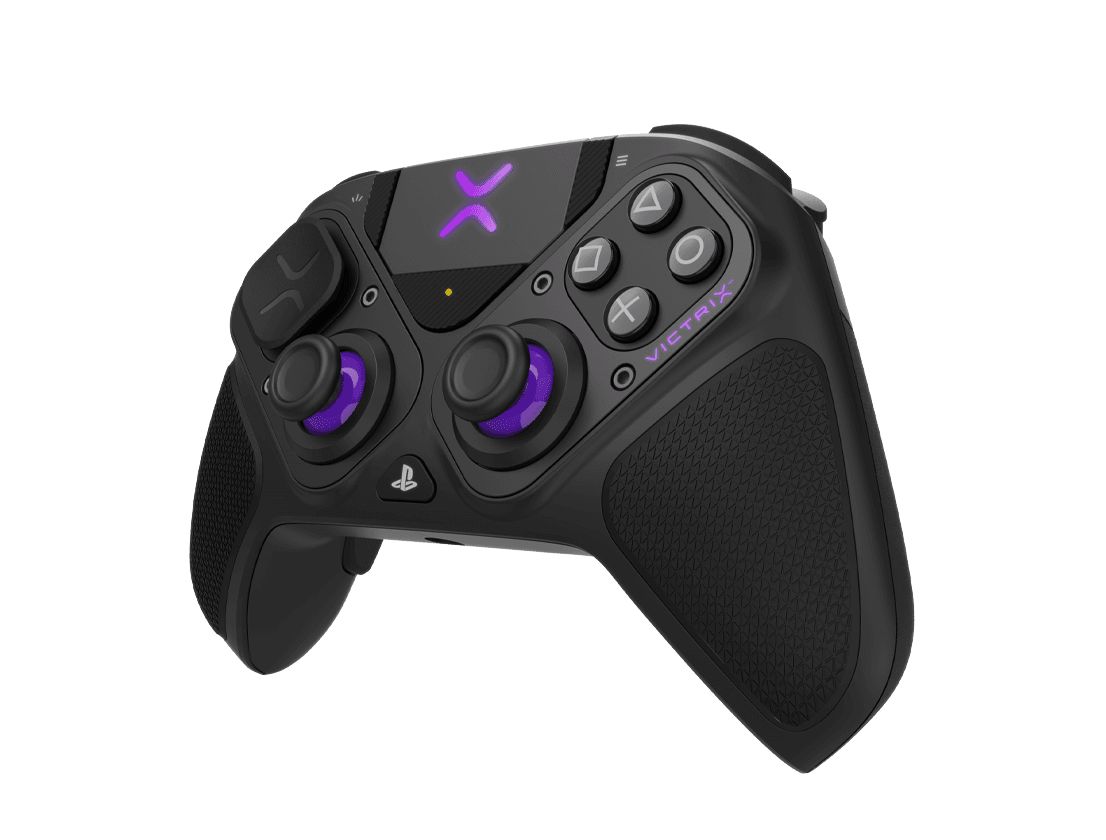
Victrix
Victrix Pro BFG
- sticks
- Swappable gates + modules
- triggers
- 5-position stops
- back buttons
- 4
- battery
- 20h+ rated
- extras
- Modular fightpad block
$169
Checked at publish
Affiliate link. We may earn a commission at no extra cost to you.
At $169 the Victrix undercuts the Edge by $30 and out-spreadsheets it almost everywhere: four back buttons to Sony's two, five trigger stop positions to Sony's three, swappable stick gates as well as modules, a modular fightpad block for the fighting game crowd, and a rated battery of 20 hours or more, which is more than triple the Edge's typical figure.
So why is it the backup and not the pick? Because the Edge's premium partly buys first-party integration, and a third-party pad cannot sell you that. The platform-defining features Sony builds into its own hardware are the Edge's moat, and for a game built around Sony's feature set, that moat is real. If your priorities are battery, button count, and modularity per dollar, the Victrix wins on the sheet and saves you $30. If you bought a PS5 partly for what the DualSense does, the Edge is the one that does all of it.
The drift-proof option: Razer Wolverine V2 Pro
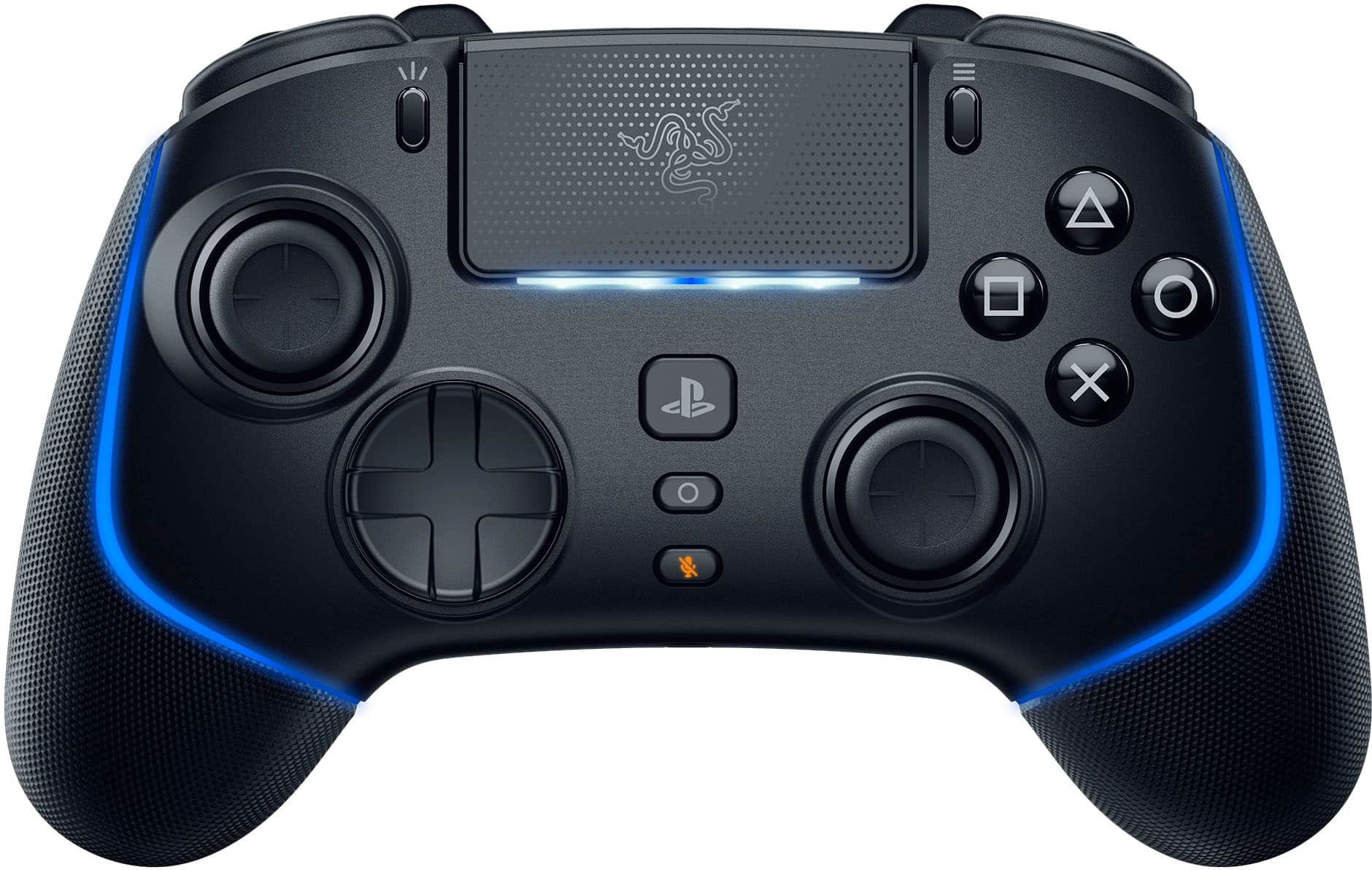
Razer
Razer Wolverine V2 Pro (PS5)
- sticks
- Hall-effect, drift-resistant
- triggers
- Mecha-tactile stops
- back buttons
- 6 programmable
- battery
- 10h+ rated
- extras
- Mecha-tactile face buttons
$150
Checked at publish
Affiliate link. We may earn a commission at no extra cost to you.
This is the controller that exposes the Edge's compromise. The Wolverine V2 Pro runs hall-effect, drift-resistant sticks: the sensor design addresses drift at the source instead of making the worn part cheaper to swap. Add six programmable back buttons, mecha-tactile stops and face buttons, and a 10 hour plus rated battery, and you have the most drift-proof, most button-dense pad in this field.
It costs $150, $49 under the Edge, and the trade is the same first-party gap as the Victrix. But the bluntness is owed: on pure drift-proofing, the pro-controller market has moved past Sony's solution, and the Edge's swap-a-module answer is the second-best engineering response to the number one cause of controller death. Sony sells you insurance. Razer sells you the version of the part that does not fail the same way. If drift has killed pads on you before and $150 is in budget, this is the rational pick, adaptive triggers or not.
A note on durability
Ratings tell you how a controller leaves the factory. A controller's verdict is really a durability verdict, and durability only shows up on the calendar. The Edge's whole value case rests on how the stick modules wear, and that is a question only months of use can answer.
Every figure in this guide is a manufacturer rating or Sony's typical figure, and is labelled as such. We have not run our own long-term wear test on these controllers, so the buying advice here is built on published specifications, Sony's stated figures, and how those numbers stack up against the rivals on price and feature count.
How to choose
- You play daily and want the full PS5 feature set: DualSense Edge at $199. The stick modules are the justification. Accept the battery, keep the cable on the arm of the couch.
- You want the most pro controller per dollar: Victrix Pro BFG at $169. More buttons, more stop positions, more than triple the rated battery, $30 less. You give up the first-party extras.
- Drift has burned you before and budget allows: Razer Wolverine V2 Pro at $150. Hall-effect sticks attack the failure mode directly. The cheapest pad in this trio, and the one engineered around the thing that kills the others.
- You play a few hours a week: standard DualSense at $74. Better battery than the Edge, same core feel, and the $125 you keep covers most of a storage upgrade, which our stock PS5 storage math suggests you will need before November anyway.
One more budget note before launch week. If the Edge money is earmarked but the rest of the setup is not, run the PS5 readiness check first: a pro controller improves every session, but it cannot fix a full SSD or a headset that dies mid-heist. Our wireless headsets under $300 guide covers the audio half of that equation.
Whatever you pick, pick it before November 19. Controller stock behaves like SSD stock in a launch window, and nobody wants to learn back-button muscle memory during the first heist.
FAQ // Straight answers
Is the DualSense Edge worth it over the standard DualSense?
If you will put serious hours into one console for the next few years, yes, mostly because of the swappable stick modules. When a stick wears out you replace a module, not a $199 controller. If you play a few hours a week, the $74 standard pad does 90 percent of the same job and holds a charge longer.
Do the DualSense Edge stick modules fix drift?
They do not prevent it. The Edge uses the same sensor type as the standard pad, so drift can still develop. What the modules change is the consequence: a worn stick becomes a module swap you can do at home in seconds instead of a warranty claim or a replacement controller. It is insurance, not immunity.
How long does the DualSense Edge battery last?
Sony's typical figure is 5 to 6 hours, against 8 to 10 hours typical for the standard DualSense. That is a real downgrade, not a rounding error. Wired play over the included braided USB cable works while charging, and the cable lock housing keeps it seated, but cordless endurance is the Edge's weakest spec.
Does the DualSense Edge have hall-effect sticks?
No. The Edge sticks are swappable modules with adjustable tension caps, but the underlying sensor is the same style as the standard pad. The Razer Wolverine V2 Pro takes the other route with hall-effect, drift-resistant sticks that address the failure mode at the sensor level rather than making the part easier to replace.
What comes in the box with the DualSense Edge?
The controller, a carry case, a braided USB cable with a lock housing so it cannot be yanked out mid-session, alternative stick caps with adjustable tension options, and two styles of back button, half-dome or lever, so you can pick the shape that suits your grip.